

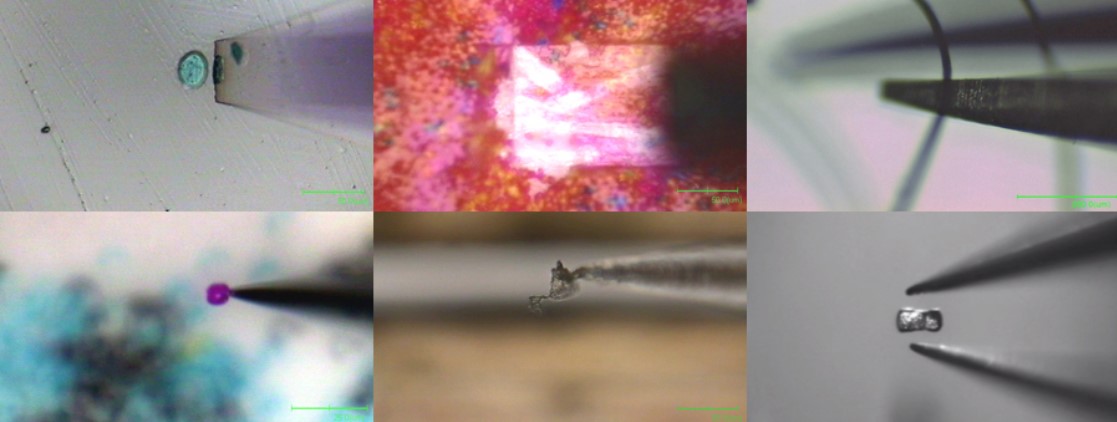
Feature 1: Sampling Micro-solids by Vacuum Tweezers
Are you having trouble picking up very small inorganics such as minerals, glass,or metal fragments? When handling inorganics, they may be repelled or blown away by static electricity during pickup, or they may simply be too heavy to lift using conventional methods. To address this, a technique in which a micro-nozzle applies vacuum suction can capture the target material securely.
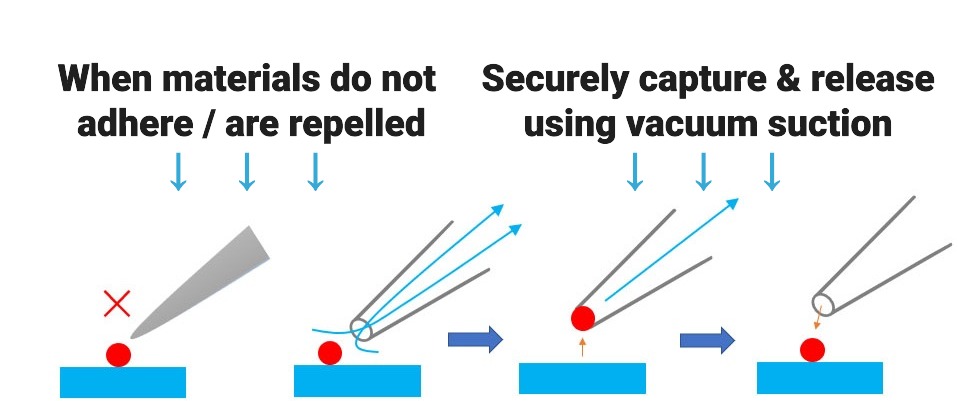
<<Principle of Vacuum Tweezers>>
A glass micro-nozzle is connected to a vacuum pump, and vacuum is appliedcontinuously to hold the target material securely by suction.
Key Points of Vacuum Tweezers
1. Observe and measure the target under a microscope to understand its condition (size, shape, etc.).
2. Select a nozzle (pipette) that is slightly smaller than the size of the target material.
3. Use the manipulator to bring the nozzle tip close to the target, switch the vacuum ON, and move closer until the material is fully attached.
4. Once attached, keep the vacuum ON, quickly move to the drop-off location, then switch the vacuum OFF to release the material.
Recommended Tools
1. Vacuum Suction Tool Set (VP-SET2) Standard type (manual operation)
2. Vacuum Suction Tool Set (VP-SET4) Model designed for integration with our manipulators
3. Micropipettes (MP Series) Available inner diameters: 5 / 10 / 20 / 50 µm Custom sizes also available.
Link : https://www.youtube.com/watch?v=o0UwNcifwcM
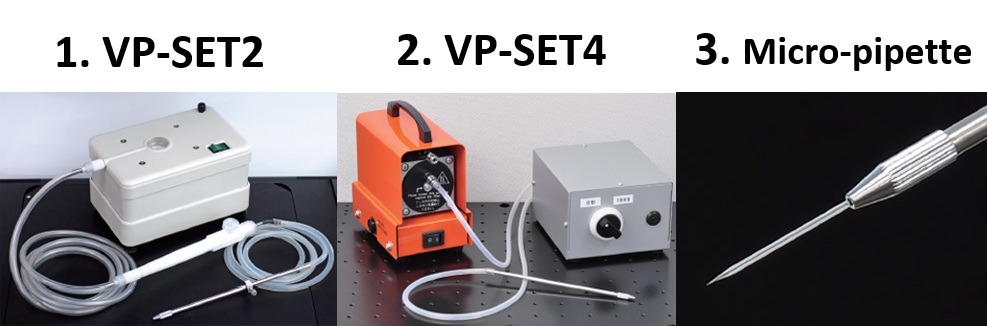
※ Due to the size and material of the nozzle (micro-pipette), we recommend using it together with a manipulator.
Feature 2: Micro-operation Supporting Equipment for Semiconductor Field
With the growing global demand for semiconductors, we have recently received an increasing number of inquiries and requests from customers involved in inorganic analysis.
In this section, based on the inquiries we have received, we would like to introduce our proposed solutions categorized by the “Challenges You Want to Solve.”
| Issues You Want to Solve | Application Image | Proposed Products |
| ・Remove micro-contamination on wafers ・Repair micro-wiring defects(connect, cuts) ・Analyze micro-foreign materials inside LCD/OEL devices ・Remove foreign substances attached to substrate terminals ・Remove and analyze micro-contamination on image sensors ・Analyze contamination on photomasks and gratings |
 Sampling Foreign Micro-substances |
・Microscope Integrated Micromanipulator-AxisPro ・Micro Tools-TP Series and others ・Micro Nozzles – MPE Series and others |
| ・Mark micro-defects on wafers for SEM analysis ・Perform marking for glass internal defect analysis before FIB processing (FIB pre-processing) ・Perform cutting or connecting wiring patterns ・Scribe substrates for cleavages |
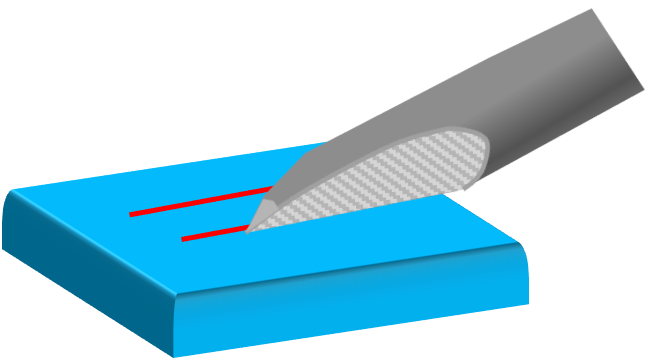 Pinpoint Marking |
・Pinpoint Marker D-MARK ・Microscope Integrated Micromanipulator -AxisPro ・Micro Tools KE-2 and others |
| ・Pick up (lift out) thin lamella after FIB processing ・Perform repositioning or reattachment in atmospheric conditions ・Work remotely in inert environment ・Reduce operation time |
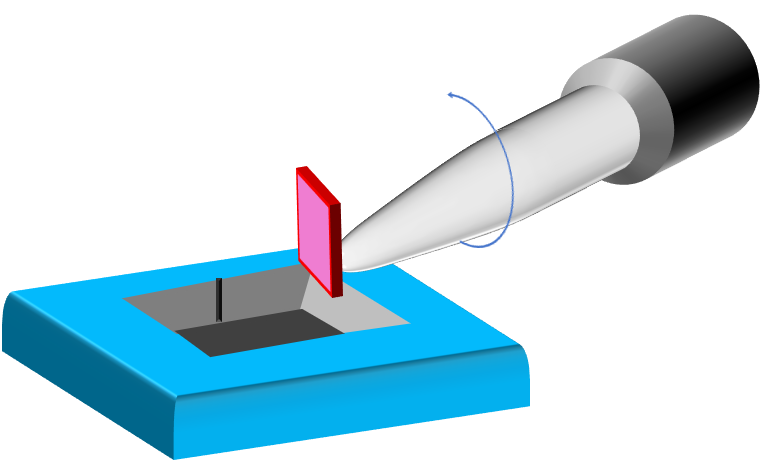 FIB-processed Lamella Lift-Out |
・Microscope Integrated Micromanipulator – AxisPro ・High-precision Rotator — HPR-2 ・Motorized Rotation Stage (1-axis / 2-axis) |
| ・Reposition diced samples without causing damage ・Move electronic components to any desired location ・Grip micro-wires and perform bonding or welding |
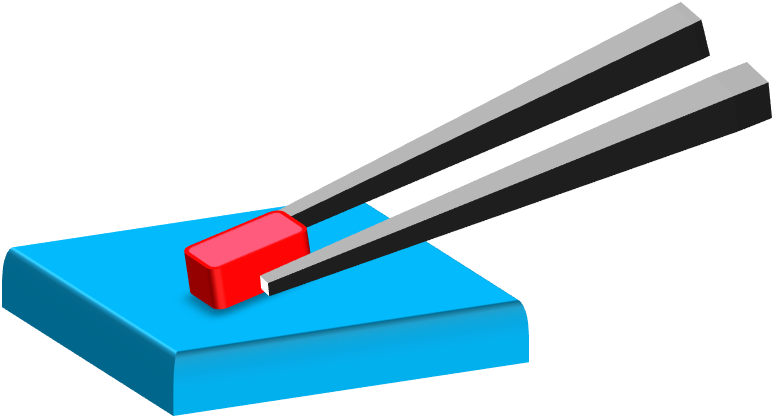 Micro-chip Holding / Suction |
・Stand-Alone Manipulator — QuickPro ・Vacuum Suction Tool Set (VP Series) ・Micro Tweezers (MTW Series) |