
At MicroSupport, we regularly publish information on micro-handling and sampling through our “MicroSupport Newsletter.” We sincerely thank you for your continued interest and support of MicroSupport.
Feature 1: Choosing the Right Tool for Sampling Work Are you struggling with tool selection? Do these concerns sound familiar?
“I want to introduce micro-tools, but I don’t know which one to choose.”
“I’m not sure if the tool I’m using now is the best fit.”
“Which tool is actually suitable for manual sampling work?”
Selecting the right tool is the key to accuracy and efficiency. To support our users, we have prepared a Micro-Tool Selection Guide, which outlines the applications and tool combinations best suited for different needs. We hope this guide will help you make confident decisions when choosing tools. You can download it here:
MICRO TOOLS&ACCESSORIES SELECTION GUIDE
This guide introduces recommended tools and includes examples of applications where tool and equipment combinations are required.
Feature 2: Handling Pico-liter Liquid Volumes: How to Use the Micro-Injector
Micro-Injector is an accessory for the Micromanipulator that enables precise handling of minute liquid volumes.

Have you ever thought:
“I already purchased it, but I’m not sure how to use it properly.”
“I plan to buy one, but can anyone really use it easily once attached to the manipulator?”
“What principle allows the handling of such tiny liquid volumes?”
“What precautions should I take when using it?”
To answer these questions, let’s start with the basic principle.
Principle
When the tip of a micro-pipette is brought into contact with liquid, capillary action begins which draws liquid into the tip. Since absorption is affected by atmospheric pressure, the liquid remains inside the micro-pipette and does not flow out on its own. Dispensing is carried out by applying pressure using the attached pump.
If liquid absorption beyond capillary action is required, the attached syringecan be fixed in place. By gradually rotating the syringe, the suction force can be increased and enable greater liquid draw into the micro-pipette.
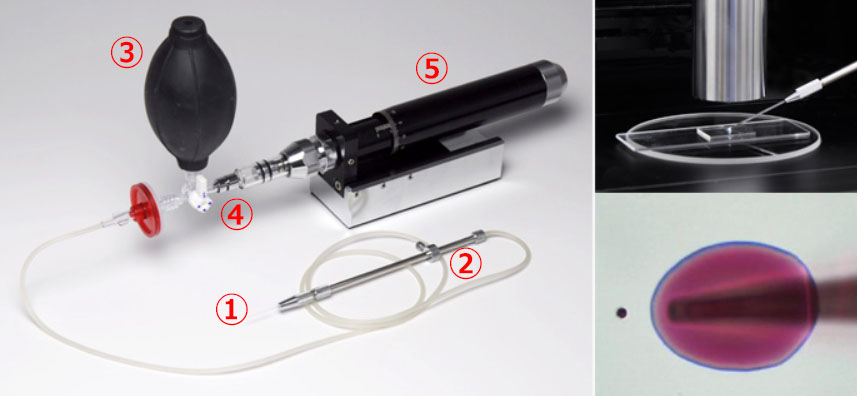
Product Components
- Micropipette (micrometre-level glass nozzle. Selectable inner diameters starting from 1 μm)
- Pipette handle (special handle for attaching to a micromanipulator)
- Pressure pump (rubber pump for applying pressure during dispensing)
- Three-way valve (used to switch flow paths during aspirating/dispensing operations) *See the video for instructions
- Injector body (a syringe that rotates to apply negative/positive pressure)
How to Use
Select the appropriate size of micro-pipette depending on the type and volume of liquid.
Attach the micro-pipette to the handle, then mount it onto the manipulator. Under microscopic observation, operate the manipulator to bring the micro-pipette tip into contact with the liquid.
Suction begins naturally via capillary action.
To dispense, connect the micro-pipette tip to the target and press the pump to release the liquid.
Application Videos (JP)
|
How to use Micro-injector |
Collection and dispensing a trace of liquid |
Continuous Dispensation of a trace of liquid |
Tips & Precautions
Always use the manipulator together with a microscope during operation. Since the Micro-pipette is made of glass, avoid handling it by hand as the tip may break easily. Be cautious not to let air bubbles enter during suction. Operate within a range where the tip can be clearly observed. Dispensing should be done gently, as if writing with a fountain pen, to smoothly transfer the liquid. The dispensing volume can be controlled by the degree of pressure applied to the pump.
Summary
When handling small liquid volumes under a microscope, it is important to understand the principle of each accessory. Every tool and accessory is based on a specific principle. If you encounter difficulties, please do not hesitate to consult with our technical engineers. By knowing not only how to operate the tool but also the principle behind it, you can achieve more reliable and effective results.